
How Occupational Therapy Can Help Strengthen Handwriting Skills
Helping Little Hands Build Big Skills: How Occupational Therapy Improves Handwriting
Handwriting is more than putting pencil to paper. It’s an important life skill that supports learning, communication, confidence, and independence. While every child develops at their own pace, some may struggle with handwriting due to challenges with fine motor skills, hand strength, coordination, visual-motor integration, or sensory processing. That’s where occupational therapy can make a meaningful difference.
How Occupational Therapy Helps
Occupational therapists (OTs) work with children to develop the foundational skills needed for successful handwriting. Rather than simply practicing letters over and over, OTs identify the underlying reasons a child may be struggling and create individualized treatment plans to address those challenges.
An occupational therapist may help improve:
- Fine motor strength and coordination
- Pencil grasp and hand positioning
- Hand-eye coordination
- Visual-motor integration
- Posture and core strength for seated activities
- Letter formation, spacing, sizing, and alignment
- Scissor skills and other classroom fine motor tasks
- Attention and sensory regulation that support learning
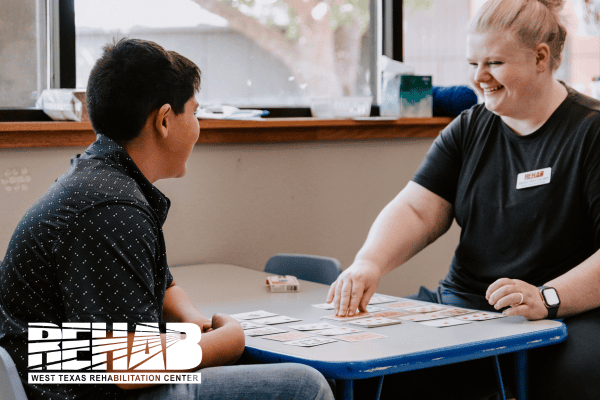
Therapy sessions are designed to be engaging and fun, using games, activities, and hands-on exercises that help children build skills while staying motivated.
Supporting Success at School and Beyond
Strong handwriting skills can improve more than just classroom performance. When children are able to write more efficiently and comfortably, they often experience increased confidence, greater participation in school activities, and less frustration with homework and written assignments.
Occupational therapists also collaborate with parents, teachers, and other caregivers to provide strategies that support continued progress in everyday environments.
Pediatric Occupational Therapy at West Texas Rehab
At West Texas Rehab, our Pediatric Therapy Department is dedicated to helping children reach their fullest potential. We understand that every child has unique strengths and challenges, and our occupational therapists develop personalized treatment plans based on each child’s individual needs.
To make therapy as accessible and convenient as possible, we provide occupational therapy services in two settings:
- In our pediatric clinics, where children receive one-on-one therapy in a specialized environment designed to promote learning and development.
- In local schools, where our therapists work directly with students in their educational setting. School-based therapy allows children to practice important skills in the environment where they use them every day while collaborating closely with teachers and school staff.
By offering services both in the clinic and at school, we can provide comprehensive support that helps children succeed wherever they learn, play, and grow.
When Should You Consider an Occupational Therapy Evaluation?
You may benefit from speaking with an occupational therapist if your child:
- Avoids writing or becomes frustrated during handwriting tasks.
- Has difficulty holding a pencil correctly.
- Writes letters that are difficult to read or inconsistently sized.
- Tires quickly during writing assignments.
- Struggles with other fine motor activities such as cutting with scissors, buttoning clothing, or using utensils.
Early intervention can help children build the skills they need before handwriting challenges begin to affect their confidence or academic success.
We’re Here to Help
Every child deserves the opportunity to succeed in the classroom and beyond. At West Texas Rehab, our pediatric occupational therapists are passionate about helping children develop the skills they need to thrive.
Whether your child receives therapy in our clinic or through services at their school, our team is committed to providing compassionate, evidence-based care that supports growth, independence, and confidence—one small step, and one handwritten word, at a time.